How it works
A reminder you can feel.
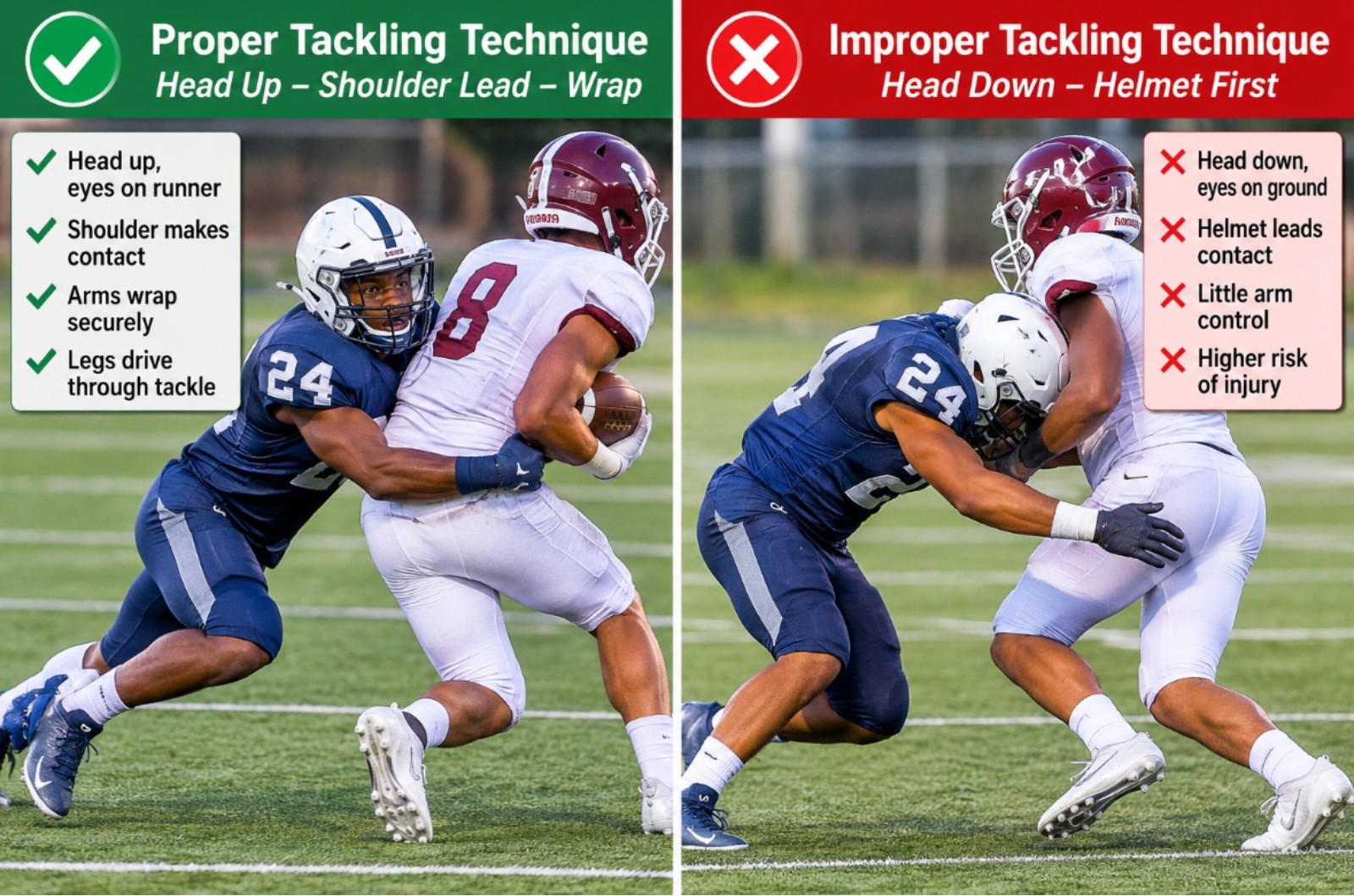
Your coach yells “head up” from the sideline. HiTS puts that reminder right on you. You feel it the moment your head drops, on every rep, even the ones nobody was watching.
Why yelling doesn’t stick
In a hit, there’s no time to think.
A coach can explain good form perfectly. A player can repeat it back word for word. Then they drop their head anyway the moment a live rep starts. That is not a discipline problem. They know it. Their body has not learned it.
Words reach the thinking mind. The player hears them, understands them, and stores them as something they know. But the half-second before a hit is far too fast to stop and remember. What takes over in that moment is body memory: the part of us that runs a movement on its own, without thinking.
Here is the problem for a coach. The body locks in a wrong habit just as easily as a right one. A player who takes two thousand practice reps with their head dropping is building that habit two thousand times.
HiTS gives you something to feel right then: a tug, the instant your head drops, every single time.
What happens on a rep.
Before the snap
The player is in their stance wearing HiTS. The strap runs from the back of the helmet to the shoulder pads, with the normal amount of slack. Nothing is pulling. Nothing feels different.
The head drops
The player’s head drops too low, past where the coach taught them to hold it. The strap runs out of slack and pulls tight. They feel a clear tug at the back of the helmet.
Head back up
The reminder comes right away. They feel it, and they can’t miss it. It happens even with the coach thirty yards away, in the middle of a drill, on the fifteenth rep of the period.
They keep playing
The player can still turn their head all the way left and right. The slide lets them look around, read the play and finish the rep as usual. Nothing about the drill has to change.
Getting out of it
It’s a strap, not a leash.
Every athletic trainer asks this first: what if a player needs to get out of it? The answer is built into the design.
- A snap that pulls apart. The strap clips to the helmet and to the body with a snap that is made to come apart when pulled. It is not a fixed tie-down, and it is not a hard stop.
- Soft, not stiff. The strap is woven webbing. It limits how far the head can move. It does not lock the head in place.
- The head still turns. The patented slide lets the head turn side to side, so the player can see a hit coming.
- Only with a coach. HiTS is meant to be worn for a set amount of time during practice, with a coach watching. Not all day, and never without a coach watching.
Every pilot program gets a written practice plan. It covers fitting, checking the gear, picking drills and how long to wear it in a session.
Youth and midget football
In one study of kids 9 to 12, about half of head hits came at practice.
Researchers put sensors inside the helmets of grade-school players in youth and midget leagues. What they found should change how coaches plan practice.
Three findings from that study matter to a coach holding a whistle:
- Head hits happened about as often in practices as in games. So roughly half of a young player’s head hits happen in the part of the week the coach fully controls.
- The team that chose to limit contact in practice had far fewer head hits, and its hardest hits were less hard, than the teams that did not. That was a coaching choice, not a piece of equipment.
- Which drill you run changed everything. Open-field tackling, one-on-one from more than three yards apart, caused the hardest head hits on average in the study. Dummy and sled drills caused none.
The American Academy of Pediatrics, a national group of children’s doctors, came to a related conclusion in 2015, in its policy statement on tackling in youth football. Teaching proper tackling, and limiting contact in practice, are two of the few things a program can actually control at these ages.
Daniel RW, Rowson S, Duma SM. “Head Impact Exposure in Youth Football: Elementary School Ages 9–12 Years and the Effect of Practice Structure.” Ann Biomed Eng. 2013. PubMed 23881111. Council on Sports Medicine and Fitness, “Tackling in Youth Football,” Pediatrics 2015;136(5):e1419. These numbers describe head hits in youth football. We show them for background. None were produced by HiTS, and none measure the effect of using it.
Past research on this kind of training
Teaching how to tackle has lowered head hits before.
fewer head hits per player, per practice or game (“athlete-exposure”), over one season. This was a randomized controlled trial, where players are put into groups by chance. It tested tackling drills done without helmets at an NCAA Division I college program.
Swartz EE et al., helmetless-tackling randomized controlled trial. Journal of Athletic Training; follow-up in Journal of Science and Medicine in Sport. University of New Hampshire summary. Evidence for this kind of training, not for HiTS.
That trial tested tackling drills without helmets, not HiTS. We cite it for one reason. It is published, randomized evidence that coaching how players tackle, not equipment, can change how often players take hits to the head.
HiTS has no results of its own yet. The 2026 pilot program is how we start collecting them. We will publish what we find either way.
The Problem
93% of NFL concussions
happened in tackles and blocks.
In 2015 and 2016, the NFL watched video of all 459 reported game concussions. Nearly all happened while a player was tackling, being tackled, blocking, or being blocked.
That is the moment the helmet goes in first. It is also the only moment in football that coaching can reliably reach.
What the player was doing at the moment of injury
Share of 459 reported NFL game concussions, by what the player was doing, 2015–2016 seasons.
Tackling, being tackled, blocking and being blocked add up to 93% of all reported game concussions. Everything else (diving, leaping, accidental contact) adds up to 7%. The injury is packed into the moment of contact, and that is the moment a player’s technique controls.
View as table
| Category | Share of concussions |
|---|---|
| Tackling | 41% |
| Being tackled | 22% |
| Blocking | 19% |
| Being blocked | 11% |
| Diving or leaping | 5% |
| Other | 2% |
Percentages are rounded and add up to 100%.
Source: NFL Player Health & Safety, video review of all 459 reported game concussions, 2015–2016 NFL seasons. New Video Review Data to Help Improve Designs for Protective Equipment. Percentages describe injuries in pro football and are shown as background on the risk. They are not measurements of HiTS.
What has changed since
The count is down. How they happen has not changed.
These seasons are not the newest count. They are the newest published look at how concussions happen. Both things are true, and we would rather say so.
The NFL reported that concussions in the 2024 season were down 17% from 2023 and 12% below the 2021–23 average. That was the lowest since league-wide tracking began. The concussion rate on kickoffs fell 43% after the Dynamic Kickoff rule. Those gains came from rule changes and better helmets, and they are real.
No rule change has altered the breakdown above. The injury still clusters in the tackling and blocking moment. Rules and padding cannot reach that part, because it comes down to what a player does with their head. HiTS does not treat or prevent any of this. It trains the one behavior a coach can actually change.
Straight talk
What HiTS does not do.
We won’t tell you this gear prevents any of this. It does not. No one has shown that any product does.
HiTS does not prevent concussions. It does not prevent neck injuries. It does not treat, diagnose or reduce the risk of the brain disease CTE (chronic traumatic encephalopathy). It is not safety gear, and it does not replace a properly fitted, certified helmet.
What HiTS does is narrower and, we think, more honest. It trains one behavior: keeping the head up through contact. It does this by letting the player feel it every single time their head drops, including on the reps the coach didn’t see.
Whether that training reduces injuries is still an open question. Answering it takes evidence we do not have yet. Getting that evidence is exactly what the pilot program is for.
A note on the numbers above
Every number in this section comes from a published source, cited where it appears. None of them were produced by HiTS, and none of them measure the effect of using HiTS. We share them to describe the problem, not to suggest a result.
See it on a real practice field.
The 2026 pilot program will give units to coaches who will tell us what really happens in a live practice. That starts once there are units to give out.